Showing posts with label Fifty Films. Show all posts

Thursday, 21 August 2025

Sorry, Baby

In an interview with the Guardian, director and actor Eva Victor described the effect of trauma on life this way: “it’s like a stone gets shoved into the river of your life. There’s a lot of pain in trying to remove it and you can’t. […] You just have to find a way for the water to move around it. It’s so unfair that someone threw a stone into your life. It’s hard to wrap your head around any of it.” It’s a powerful image to describe the before and after when a caesura occurs. It makes the decision to follow Agnes through a few years of her life in a non-chronological way more powerful. A kind stranger she meets at a horrible moment, when she has a panic attack in her car following a revelation about a friend and enemy, tells her that three years are a long time but also not that much time. She talks about how being immersed in the memory of her rape is horrible, but sometimes it’s even more awful to find herself not thinking about it at all. Maybe these years unfold like memories, which people don’t access chronologically but randomly. Healing from trauma is not a straight line, a clear process with constant improvements. 

The film begins with a visit from Agnes’ best friend Lydie (Naomi Ackie). Their closeness and intimacy shines through every scene they share. This is before the viewer knows much about either of these characters, and so much is communicated just through how they are around each other. There is quiet concern from Lydie about Agnes’ well-being, a question about how much she leaves the house. There is specifically horror about her now having an office at the University, where she is a full-time lecturer, that was previously occupied by someone who has done her harm. 
A time jump returns us to before: Agnes and Lydie are working on their dissertations. Their advisor is Preston (Louis Cancelmi). He obviously favours Agnes over the other students and is over-complementary about her writing. She may have a crush on him. One day, he invites her over to his house. We don’t follow her into the house – we see her walk in, and then, after a period of time, leave in a rush, clearly distressed. She gets into her car and drives home to Lydie, where she haltingly talks about what happened. 
What struck me about that distressed retelling of the rape, the individual and escalating steps of not accepting her refusals and seeing her as a person with agency over her body, is how difficult she finds it to make it into a coherent narrative: it’s filled with questions, with doubts. Lydie throughout is supportive and gentle. She doesn’t push or judge. It stands in contrast to what happens when they go to a doctor the next day and experience the horror that awaits rape survivors after the worst thing has happened. The doctor is pushy, aggressive in his questioning, abrupt. Calling it poor bedside manners doesn’t begin to describe how horrible the experience is, or how much worse it may have been if she didn’t have an advocate by her side who calls the doctor out for his clear inability to approach the situation appropriately. A similar thing happens later, when the panicked University administration tells Agnes that there is nothing they can do because Preston has resigned before she brought her accusation. There will be no accountability. The two women tell her that they understand what she is going through because “we are women”. It’s such an unbelievable statement after they’ve told her they will do nothing that Agnes has to ask them to repeat it before it sinks in. 

In another scene from her life, Agnes is called up for jury duty and finds herself asked to recount having once been the victim of a crime when a lawyer asks her if that experience would impede her ability to be a juror. It’s a reminder of how surprisingly these moments of being pulled back into her worst memory can pop up, and she refuses to share what happened with these strangers because they have no right to her story. It’s also, in the broader sense, a judgement on the narrowness of procedures can never encompass the totality of the very personal experience, not unlike the way in which the narrowness of the gender categories on the form she has to fill in force her to pencil in a third option. “I don't want him to go to jail. I want him to stop being someone who does that. And if he went to jail, he'd just be someone who does that, who's now in jail.” she explains, before she’s excused. 
Along with these deeply unpleasant encounters that showcase how difficult it is to find any kind of accountability or justice the film portrays some moments that are almost magical in nature. She finds a stray kitten just when she needs it, and it allows her to pick it up and adopt it on the spot. A neighbour the house over is haplessly lovely (one of the funniest scenes of the film is when she asks to borrow some lighter fluid, clearly intending to use it for something other than a barbecue) and becomes a companion when Lydie moves away. The film isn’t saccharine enough to promise instant healing, and even these moments of grace come with the realistic portrayal or pet ownership (the kitten brutally mauls a mouse that Agnes has to mercy-kill) and the possible mismatches of romantic relationships (Gavin in essence tells her that she will one day want children as a fact, having no idea how far off that kind of long-time planning is for Agnes at the moment). 
The film provides such an interesting balance of comforting companionship (the kitten, Lydie, the kind stranger) and the human equivalent of irritating barbs – the only way I can describe the great Kelly McCormack’s (Killjoys, A League of Their Own) character Natasha is as a weaponised version of Anya in Buffy, a person unhindered by any traditional concepts of manners and politeness. Natasha is deeply jealous of everything that Agnes has and treats her like her worst enemy, and there is nothing that Agnes can do to change the fact. Natasha is terrible at a dinner party, and appears to regularly peek into her classroom furiously, resenting that she has attained the highly competitive full-time position. Finally, Natasha grudgingly accepts that Agnes may have, from her perspective, everything, including being likeable, but that she has so far not managed to win her over. Agnes has suffered a terrible trauma, but it’s almost like the presence of the constant, completely irrational irritation of Natasha is a reminder that life continues irrespectively. 

One of my favourite moments in the film follows Agnes into her classroom, where she teaches contemporary literature. It’s clear that she deserves the position but there is a heartbreaking moment where the University tells her she received recommendations from former teachers, one of which echoed what Preston said about her dissertation – extraordinary. It’s an irrefutable reminder of how entangled the rape is with her current career, but then, in the classroom, the film captures how good she is at her job, how confident with the students and the material when they are reading, of all things, Nabokov’s Lolita, and she explains to them the conflict between the beauty of form and the horrors of the content. 

The most moving moments of the film lie in Lydie’s concern for Agnes’ well-being, the precarious balance between her own life moving on excitingly – embracing her queerness, marrying her partner, having a baby – and returning to Agnes, who still lives in the same house and now occupies the office where her rapist once worked, and teaches in his former classrooms. Lydie recognises Agnes’ continued suffering – at one point she pleads with her not to die, and I think she means it literally and in terms of not making her life smaller and smaller. In the final scenes of the movie Lydie visits again, this time with her partner and baby, and Agnes looks after the baby while they go on a walk on their own. She has a moment where she talks to the baby about the future, about wanting to be the kind of person that she can talk to about everything, especially the scary things, without judgement or fear. 

This is a beautiful debut film from Eva Victor, and one of the best films this year. 

2025, directed by Eva Victor, starring Eva Victor, Naomi Ackie, Kelly McCormack, Lucas Hedges, Louis Cancelmi, Hettienne Park.

Sunday, 5 February 2023

The Miseducation of Cameron Post

“The afternoon my parents died, I was out shoplifting with Irene Klauson.”
This is how emily m. danforth’s novel starts. Cameron at this stage is just out of childhood, and she loses her parents the same day that a dare with her best friend Irene opens up a whole new world to her. It’s an unfortunate coincidence that Cameron’s first kiss with another girl ends with the trauma of losing her parents, as the guilt of that moment, and the question of whether her parents’ death was somehow a punishment by god for her behaviour, haunts her for the rest of her youth. 
Desiree Akhavan’s adaptation never shows us this moment. In fact, nearly all of the details of Cameron’s youth in Montana’s Miles City, which take up about two thirds of the novel, are missing from the film. 
What Desiree Akhavan does achieve, in spite of only focusing on a narrow part of danforth’s novel, is still remarkable. She creates a foundational trauma that happens in a flash of quickly-paced scenes, Cameron (Chloë Grace Moretz, somehow perfectly cast for this) and Coley (Quinn Shepherd, a few years ago very impressive with a short but memorable stint on Person of Interest) stumbling, kissing against walls, stealing moments away together, in secret, until they are finally discovered by Cameron’s homecoming-date and best friend Jamie after having sex in a car. There’s no need to really hear what happens after, because we can guess, even without having read the book: Jamie, making horrified noises while Cam tries to put her clothes back on and Coley weeps in the car, inconsolable, ashamed, Cam being sat down by her Aunt Ruth, and then, Cam being taken away to God’s Promise, an evangelical conversion therapy centre. 

We don’t really know much about Cam at this point in the film, while she is well-established in the book, and it’s hard to judge how this moment of horror would play out for someone who isn’t familiar with Cameron Post from danforth’s writing. In the book, it’s the culmination of her low-key struggle with Aunt Ruth, who comes to raise her after her parents’ death because her grandmother isn’t really able to do it by herself, as kind and gentle as she is with Cameron’s identity and grief. Aunt Ruth means well, which is probably the worst part of it, because Cameron prior to that point has been raised in an agnostic household and now has to cope with a re-born evangelical Christian who thinks she is saving her niece’s soul by making her go to Church, church group, and eventually, the conversion camp. There is no ill-intent in this, or even hatred, just an utterly and horribly misguided love. 
Cameron herself is – sarcastic, stubborn, questioning. She takes what she’s learned about herself with first best friend Irene Klauson to the same place that so many other queer kids have taken their questions – film -  and educates herself via her small town’s videostore (because the book, and the film for that matter, are set in the early Nineties), sharpening her sense on classic film Personal Best. She runs wild with her best friends (so many scenes in the book are memorably set in an abandoned hospital building, and some of the allure of it comes from how free these kids are to do with their days more or less as they wish, without much parental supervision). She swims competitively and meets a gay girl who is about to move to the Pacific Northwest, and will send her dispatches in the form of letters, phone calls and riot grrrl mixtapes from a world where it seems so much easier to be gay. Cam soaks all of it up, and tries to find meaning, in a way, between her attempts to comprehend how it relates to her parents’ death and to being in a small town, trying to shape an identity, until she falls in love with Coley. 

I think it’s worth knowing all of this while watching the film, I think it adds to the layers and layers, as much as the film works on its own. It adds to know how falling in love with Coley feels to Cameron like a bomb going off, an inevitable time bomb that will blow everything apart. Lindsey, her gay friend, from far away cautions her not to go after a straight girl, but Cam can’t help herself (plus Coley isn’t exactly straight, just scared out of her mind). In the book, she seduces her by using The Hunger (in the film, it’s Donna Deitch's beautiful drama Desert Hearts, in both cases it’s good they never make it to the end). Like in the film, they get caught, and Cam is the one paying the price, the one carrying the burden, the one sent off to the conversion camp. 

A lot of the complexities of Cameron at this point are hard to convey in a film that mostly relies on sparse and predominantly sarcastic dialogue between its main characters as well as facial expressions to tell its story. In the novel, Cameron narrates her own story, and she is particularly good at capturing how seasons, weather and landscape play into people’s behaviour – especially kids who are still in school, who come to life during summer holidays. When she arrives at God’s Promise she is shell-shocked – the moment when she and Coley got caught in the car replays a few times, in particular Coley’s refusal to be comforted, and Cameron’s guilt because she thinks that she made her do something she didn’t want to. Since the film doesn’t have the connection between Cameron’s realisation that she is gay and the death of her parents, it uses the guilt over having seduced Coley to turn Cameron into a character who isn’t entirely opposed to the teachings of God’s Promise. It’s the same position the occupies in the book – somewhere between the kids who are there believing deeply and profoundly that they are wrong, and require healing, and the kids who know they are only there because their parents are wrong and misguided, that they only have to survive long enough, or play the game, to be free again. It would be much easier to watch a character interrogate the teachings of God’s Promise from the start, refusing the buy into it entirely – like Cameron’s soon-to-be friends Jane Fonda (Sasha Lane, as perfectly aloof and cool as Jane Fonda is in the book) and Adam do, who have created their own little community of ditch-weed smoking survivors of Dr. Lydia’s heinous teachings. We don’t see too much of that teaching on the screen, the main part is the theory of the iceberg, according to which gayness is only the part of the problem that is obvious to the eye, whereas the majority of the kids’ issues remain buried under the sea, and require (for the most part, profoundly traumatising) inspection before they can hope to overcome their SSA. Cameron is curious enough about that part that she investigates everyone else’s iceberg, trying to understand everyone along the lines of Rick and Lydia’s interpretation of their identity, trying to fill in her own iceberg to understand herself. In the novel, the iceberg fits in well with Cameron’s previous attempt at finding a metaphor for her complex inner life – after her parents’ death, she starts to decorate a dollhouse from her childhood with found and stolen objects, but maybe in 2018, after Sharp Objects, it’s for the better that this detail didn’t make it into Akhavan’s film. 

Since this is 1993, Cameron doesn’t really have the same luxury of being able to just refute the claims of Reverend Rick and his much easier to hate sister Dr. Lydia from the start. As much as Jane and Adam attempt to make her understand that there are other villains in her story – Coley, for one, once she figures out that she was the one who ratted her out, not her friend Jamie – there is still a part of Cameron driven by guilt that buys into some of the thing that God’s Promise is selling, even if she isn’t as completely convinced by it as her room-mate Erin and some of the other kids are. It’s so easy for Rick and Lydia to sell the idea that being gay is wrong because it matches what the kids have heard from the people who’ve sent them there – who are meant to love them unconditionally, and care for them – and because in 1993, it would’ve been easier to argue that having a family, and living a life not burdened with adversity and conflict, is easier when you’re straight. 
It takes a while for Cameron to catch on to the fact that Rick and Lydia have absolutely no idea what they are doing, that their hack-psychology isn’t cut out to deal with actual crises, that their limited conception of self and personhood creates an atmosphere in which someone will inevitably break, even more so because some of these children weren’t sent there by loving parents or guardians who wanted the best for them, but hateful and despicable irresponsible people who want what they think is evil cut out of their children, with no regard to their mental and physical well-being. The most horrible moment in the film is taken directly from the book – it’s when Mark (Owen Campbell, absolutely remarkable in the role), the poster boy for the camp’s success, a kid who passionately quotes scripture, believes profoundly in the teachings, and is so lovable and compassionate on the phone that he brings in most of the donations finds out that his father is still refusing to let him come home because he remains too effeminate. Distressed, he quotes scripture in group therapy that makes it clear how much he has been made to hate himself. Rick and Lydia, utterly incompetent, leave him alone, and he severely hurts himself. 

It’s a horrible moment in which Cameron finally realises that these people who are meant to be responsible for the children under their care are not capable of caring for them, that these amateurs do not know what they are doing. Ironically, an investigator is sent to question the kids about the conditions in the camp (the man tells her, point-blank, that he is there to investigate practices, not judge the intent behind it). He asks if she trusts the Rick and Lydia, if she believes that they have her best interest at heart, and Cameron can’t even begin to put into words how impossible that question is to answer in the affirmative. Rick and Lydia and the culture their represent are tasked with destroying any sense of self-possession and self-knowledge, any sense of true identity, that the kids have, and Mark’s fate is only the most jarring example of what happens when those things are taken away from a person. 

A more quiet moment, and one that I’m so glad has made it from the page into the film, is between Erin and Cameron. The film, like the book, very intentionally plays Viking Erin (Emily Skeggs doing perfect magic) up for laughs – her obsession with a sports team, her narrative of herself as being gay because she is too much into sports, and bonded with her dad over it, her earnestness in trying to become straight, her attempts to become more fit to hilarious “Blesserzise” videotapes. Cameron is so caught up in her blooming friendship with Adam and Jane Fonda and trying to make sense of her remaining feelings for Coley that she completely misses the many moments where it’s pretty clear how much Erin cares for her – until Erin literally leaps on her, after Cam has a vivid sex dream, to try and save her from having evil thoughts until she changes her mind and makes her come instead. She still insists, after, that she wants to become straight, that she wants a “normal” life, except it’s so clear, in everything she does, that she likes Cameron too much. It’s like a transformation happens in those few minutes, where Erin goes from a character played for laughs to turning into a whole complex sexual being (who responds to Cameron, after she says that she really didn’t see it coming, that it is because she didn’t think of her that way – and she sounds like she deeply wants to be thought of that way), where she gloriously triumphs over all the moments where anyone would’ve made fun of her for being too much into God. The fact that God’s Promise is trying to eradicate this spirit and passion out of her is as much proof of its failings at basic humanity as Mark’s horrible act of self-destruction is. 

This is why The Miseducation of Cameron Post is at its best when it reminds us that the kids trapped at God’s Promise are exactly that, teenagers who are trying to make sense of themselves, who become gloriously themselves when they are finally able to turn a radio to a non-Christian-rock radio station and sing “What’s Going On” together (perfect, in a way, after Sense8 two years ago). God’s Promise is trying to break them down so it can more successfully instil its hideous ideology – another horrible moment is when Lydia cuts off Adam’s (Forrest Goodluck) beautiful hair, an act of pure hatred against his identity that refuses to be shaped into evangelical Christian forms. Rick and Lydia’s agenda ultimately has to fail because the sheer amount of life, of passion, of desire for freedom that refuses to be beaten or prayed out of Adam, Jane Fonda and Cam will carry them into a life far away from this horror. At least that’s the note the film ends on – the three of them, riding away from God’s Promise in the back of a pick-up truck, playfully and freely flirting with a real life of their own. 
It’s a much less ambiguous ending than danforth’s novel, which, because it starts the way it does, ends with Cameron swimming the lake in which her parents perished, attempting to make sense of how her loss and her grief connect to how and whom she loves. In both cases, it would have been wasted time to prosecute the institutions we already know are evil, and it is glorious to see instead a celebration of those who successfully overcome, simply by being free. 

2018, directed by Desiree Akhavan, starring Chloë Grace Moretz, Sasha Lane, Forrest Goodluck, Emily Skeggs, Owen Campbell, John Gallagher Jr., Quinn Shephard, Jennifer Ehle.

Originally published in 2018

Friday, 4 February 2022

Fear Street


I knew Simon. 

He was funny and brave. 

And I knew Kate. 

She was smart and kind and...

Fearless.

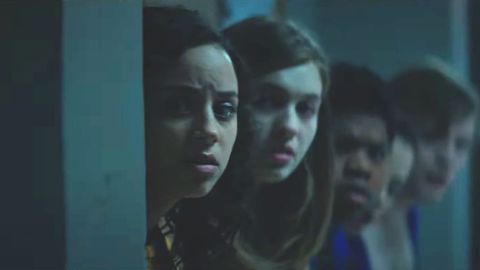
The first Fear Street (1994) took me right back to watching late Nineties/early 2000s slasher films – surrounded by friends, sweets and chips packets, we burned through all of them, with differing levels of tolerance for the violence, screaming in unison at the jump scares. It stands out as a period of time for me – it was never at the cinema, always in someone’s childhood bedroom or the family living room, always on video cassettes. Later, when we were old enough to be admitted to those kinds of films in a movie theatre, we would just end up watching much tamer fare, falling back on teen comedies. 

What stands out to me about those films that I’ve never gone back to – especially Scream, the classic of the genre – is that I can barely remember the victims. I can conjure up the forever final girl, Neve Campbell’s Sidney Prescott, surviving all that was thrown at her, I can see the faces of Matthew Lillard and Skeet Ulrich, but not any of the other friends who didn’t make it through the film. Drew Barrymore’s cameo remains memorable, of course – the most recognisable actress at the time, dead almost as soon as she appears – but otherwise, there’s a blank. Maybe it has something to do with not seeing myself on screen, not feeling represented – we were too young at the time, years away from these teenagers, but they were also uniformly straight in that particular 1990s way, not just in the most obvious way, but also culturally. 

What Leigh Janiak accomplishes in these three films feels almost like reclamation of the genre, and it’s written in the very concept of Fear Street. There’s the division between Shadyside, forever struggling with sudden outbursts of terrifying slasher violence, creating a socio-economic prison for kids who will never be able to leave, just as their parents could never leave, generations and generations back to the founding of the town in 1666, and Sunnyvale, which is reaping the rewards of generational wealth, thriving without crime. Shadyside is literally a place of darkness, and Sunnyside is a place of light, a rift that appears to be inescapable throughout history. The depression of Shadyside is inscribed in the characters – especially in Deena (a great Kiana Madeira), our heroine, whose tagline is “Welcome to the suck. Shit is doomed!”. Deena understands how Shadyside works, that nobody makes it out alive, that whatever darkness haunts the town goes beyond the regular murders – it’s generation poverty that is trapping her and her friends, in spite of their attempts to leave, to support their families with shitty jobs, to find meaning and joy in each other’s friendships. The film begins with an homage to Scream – Maya Hawke’s Heather, working at the local mall, doesn’t make it out of the latest killing spree alive, becoming a victim to her friend, a motive that is repeated throughout history, with people who appeared to be normal and loved suddenly becoming possessed, leaving havoc behind, the narrative of another Shadysider snapping ready to be printed immediately. 

The beating heart of the series – apart from the dark, evil heart underneath the town – is Deena’s relationship with ex-girlfriend Sam (Olivia Scott Welch), who hasn’t just betrayed her by not wanting to be out, but more fundamentally by moving to Sunnyvale after her parents’ divorce. Deena’s resentment is deep and irrational to an extent, since Sam had no control over the move, but Deena sees Sam’s move to the sunny side as inauthentic – a false hope of a future outside of their doomed town, a switch to the enemy, the taunting, cruel children of the rich. Beyond the horrors of the ever-returning slashers, it is the cruelty of Sunnyvale that resonates more, the crimes of the privileged against the struggling, with adults either being absent entirely, ineffective, or downright evil themselves. 

Deena’s resentment explodes during a high school football game – Sunnydale vs Shadyside results in violence, Sam’s idiot new boyfriend chases the team bus in his car, Deena takes revenge, causing a car crash, that results in Sam getting serious injured, but also bleeding on the buried bones of famed urban legend witch Sarah Fier, putting her in the cross-hairs of all the monsters of the past who begin emerging, attracted by her blood. Deena capably assembles a scooby team out of her best friend Simon (Fred Hechinger), brother Josh (Benjamin Flores Jr.) and best friend Kate (Julia Rehwald) to save Sam – and here’s where the true magic in Fear Street happens. Where Scream’s victims remain unremarkable, Leigh Janiak manages to make us love each and everyone one of them – all of them outsiders and weirdos, dealing with the economic struggles of living in Shadyside in their own way. Simon has been supporting his family by working in the local grocery store (he’s been the employee of the month for years). Josh is obsessed with local history, and helps solve what is happening to them with his encyclopaedic knowledge about the violence of Shadyside. Kate – president of all clubs, school valedictorian – has a side hustle as a drug dealer with which she hopes to one day escape to college. They are fiercely loyal to Deena and each other (Sam, maybe not quite as much, adopting some of Deena’s resentment, which soon melts once they rekindle their relationship gently), they are incredibly brave in the face of absolute, visceral terror, and two of them meet brutal ends that hit all the harder because they’re fully formed characters that we as an audience are rooting for. And in the end, Sam isn’t entirely saved, instead possessed by the same curse that has turned so many others into killers – and Deena has to learn more about the history of the place she hates so much to find a way to save her. 

Deena’s stubbornness and love are the bookends for the series – in 1978, we witness the sole survivor of a previous attack, played in the present time by Gillian Jacobs (I’d put her on a list of possible modern versions for Yellowjackets’ Van after this), and by Stranger Thing’s Sadie Sink back in the Nightwing (what a name!) summer camp in the Seventies. Ziggy is like Deena in many ways, hateful of Shadyside but more so of her sister, who has hopes for the future and has attempted to transform herself into someone new, leaving the other outsiders behind. Like in 1994, there is an insurmountable division between Shadyside and Sunnyvale, with the Sunnyvale campers cruelly teaming together to torture Ziggy and others – it’s our first sign that maybe the historical reading of Shadyside’s history is wrong, that this isn’t in fact the revenge of a witch that was killed, since the result of whatever happened appears to be that Sunnyvale forever profits from the poverty of Shadyside. Again, the characters are drawn with care, so that their death hits all the harder, and this time, it’s not just the victims – it’s also the first time that we get a clear sense of what it means to have people’s friends and loved ones turned into killers out of nowhere, without an explanation. Ziggy is saved by a young Will Goode (Brandon Spink), who will later become the local sheriff – a Sunnysider predestined for greatness even then, who appears to be carrying a heavy burden. But again, there are still pieces of the puzzle missing, and Fear Street 1666 finally travels all the way back to the beginnings. 

1994 stands out for me and could work as a stand-alone film – it would make sense that the setting was required because some of this wouldn’t work with the addition of more functional internet and mobile phones, plus it is always great to be able to use Portishead and Radiohead. But 1666 is what really surprised me – it doesn’t go the way of The VVitch, which presented a profoundly small community in the throes of religious zeal, far removed from contemporary understanding of reality. In Union (the settlement preceding Shadyside and Sunnyvale, undivided), the young people are not unlike the ones we see in 1978 and 1994 – looking for the joys available to them in the deprivation, meeting up under the full moon to drink and do drugs, to wring some kind of liveable life out of the horrors of a precarious historical time. And again, there’s love – Sarah Fier (played by both Kiana Madeira and Elizabeth Scopel) and Hannah Miller (Olivia Scott Welch, mirroring 1994) steal away for kisses, constantly aware of what their community would do to them if they knew. It is fitting that we see the same actors assuming the roles of their ancestors, since the curse appears to trap everyone within the confines of the doomed land, where nobody ever gets to truly leave unless it’s in a bodybag. The inevitable witch hunt begins when the pastor goes insane, gouging out the eyes of children and killing them, an event so gruesome that his flock immediately decides that there must be a darker force at play – and of course their eyes turn towards the stay youth, and specifically, Sarah Fier, who is too different to not become the focus of everyone’s ire. She is unmarried, not allowing her father to give her to the local widower Solomon Goode (Ashley Zukerman, playing Will’s forefather). 1666 undermines our expectation – the easy story that we’ve heard before, a witch who was killed dooming the community that murdered her to centuries of misery. Instead this becomes a story about male entitlement, Solomon Goode desiring a better life for himself so much that he makes a pact with the devil, creating the rift that will see his family in power and light forever, and Shadyside in the dark. Sarah sacrifices herself to preserve the life of her beloved (her friends gently give her a good burial, horrified by what their parents have done to her), but she also curses Solomon, promising that she will eventually revenge what he has done – and this is what Deena does, once she has solved the mystery, aided by Josh, Ziggy and Martin, a man who Will has repeatedly framed for no apparent reason except cruelty. In the end, the true villain of the story – a villain throughout all the branches of the Goode’s family tree – is a man so keen on power and riches that he would sacrifice generation after generation of young Shadysiders. It is only when Deena succeeds in turning his monsters against them that the curse is lifted and Sam is saved – their love prevailing against all odds, a queer triumph. They emerge in the Goode’s mansion, with all of their riches openly displayed, into the beautiful streets of a town that has never been affected by the darkness of its neighbour – but now the fates have turned. 

Fear Street: 1994, directed by Leigh Janiak, starring Kiana Madeira, Julia Rehwald, Olivia Scott Welch, Fred Hechinger, Benjamin Flores Jr., Ashley Zukerman. 

Fear Street: 1978, directed by Leigh Janiak, starring Sadie Sink, Ted Sutherland, Emily Rudd, Chiara Aurelia. 

Fear Street: 1666, directed by Leigh Janiak, starring Kiana Madeira, Elizabeth Scopel, Benjamin Flores Jr., Julia Rehwald, Fred Hechinger, Olivia Scott Welch, Ashley Zukerman. 

Thursday, 7 July 2016

The VVitch: A New-England Folktale


In Jennifer Kent's The Babadook, the horror of the film isn't necessarily just caused by the titular character, but by the isolation and co-dependence of its two main characters, the mother and her child. They are isolated in their grief and their attempts to put their lives back together, and their normality crumbles even more when the child becomes more difficult to deal with and lives increasingly in a fantasy world, and the mother starts to suffer from severe mental health issues in addition to the grief and the stress that she was incapable of coping with before. Both of them are vulnerable due to their situation, but the mother becomes the danger - and an unmitigated one, because there barely is an outside world - once rationality falls away. Isolated from the outside world, with nothing but each other to trust, they both shape their reality, and the inner fantasy world of the boy, with the Babadook posing a threat, becomes a very real threat once the mother succumbs to it. At that point, the question of which part of it is real and what is simply an expression of a psychotic episode becomes irrelevant: it is real for both main characters, and there is no outside perspective of their perception of reality to make any such judgement. 

Isolation and its effect on a family that has no outside point of reference anymore plays a similar role in Robert Eggers' The VVitch, but he expands this version of horror by translating it into a tightly-knit Puritan family in 17th century New England, a family that was cast out from its community for an unnamed transgression. Presumably, William, the head of the family, interprets the doctrines of their faith differently than the leading figures in the colonial village.
The family now lives isolated on the verge of a forest, depending on a failed harvest of corn that is affected by ergo, a fungus that can cause hallucinations, and offers one of the many possible interpretations of the story. They have been cast out so now their only community, their only reference point for reality, is the doctrine and interpretation of events that their parents, especially their father, offers, and his understanding of the world is shaped by his religion. 
To paraphrase a quote used in Donna Tartt's The Secret History - to understand Milton, the reader must try to become religious while he is reading, because otherwise, it is impossible to comprehend his books. It is not simply necessary to understand the frame of mind - to understand that William, his wife and his children are deeply religious, and that this religion is the only guiding post that they have when they are confronted by incomprehensible events - but the viewer of the film has to accept that world view to understand what is happening in the film. A baby disappears into the woods, while it is under the care of the oldest child, Thomasin. Thomasin is a teenager in a world that hasn't yet invented teenagers, and her blossoming and becoming is endangering the unity of the family (the oldest son, bearing the other half of the responsibility, steals secret glances). The viewer, at this point, is trapped between an outside perspective, after having seen the witch do unspeakable things to the baby earlier, but also recognising the spiral into which the parents fall once the son disappears and further bad luck befalls the family as an expression of religious fervour that is a threat in and of itself. 
Many things fall into place - the son, trying to protect the family from starvation and trying to give hope, goes off to empty his father's secret traps in the woods, even though the mother considers these woods taboo and the source of evil. He disappears, the horse runs off, and when he comes back, he is horrifyingly sick, finally succumbing and dying. The two youngest children, existing in a fantasy world of their own, accuse the oldest daughter of communing with the devil, which, in combination with the misfortune, leads to her parents considering her responsible for everything. What should have been an outlandish claim, made by two children in jest, in play, is taken much too seriously because any claim of evil must be examined in this world. It should be impossible for an adult to take claims of the devil inhabiting the black family goat seriously, and yet, in this world and time, it is the most likely explanation. There is no outside source of rationalism, or any kind of secular intervention here - the devil having a personal stake in the misfortune of this family, and a young woman bearing the brunt of that threat simply because of who she is, are the only possible explanations. 

Eggers, along with a stellar cast, does a fantastic job at portraying the claustrophobic atmosphere, the normality of family life succumbing to the irrational horrors and interpretations, barriers breaking down, and finally, violence destroying everything. The characters speak the historically accurate language that is so deeply influenced by religion that it would seem impossible that even their most intimate thoughts could ever escape the limitations of the very language that gives shape to them. Many interpretations of the ending are possible, but regardless if we believe the quite literal one most in line with this being a classical horror film that simply happens to be set in a different time or assume that the intention here was to film a beautiful if violent metaphor for a feminist awakening, the outcome is the same. Thomasin kills her family and goes off to dance with the witches in the woods, for a sabbath that is radically different from the suffocating and hopeless slow demise in the small cabin near the woods. 

2015, directed by Robert Eggers, starring Anya Taylor-Joy, Ralph Ineson, Kate Dickie, Harvey Scrimshaw, Ellie Grainger, Lucas Dawson.

Monday, 9 February 2015

Horror Starts at Home

“I'll kill the monster when it comes. I'll smash its head in.” 
"For the first time in my life, I saw the place for what it was: lethal, shaped and honed for destruction as expertly as the trap lurking in the Spains' attic. The menace of it left me blinded, sang like hornets in the bones of my skull. We need straight lines to keep us safe, we need walls; we build solid concrete boxes, signposts, packed skylines, because we need them. Without any of that to hold them down, Pat's mind and Jenny's had flown wild, zigzagging in unmapped space, tied to nothing."
Both Jennifer Kent, in her 2014 film The Babadook, and Tana French, in her 2012 novel Broken Harbour tackle the idea of possession. The Babadook is a psychological horror film from the start, Broken Harbour starts as a crime novel, like Tana French’s previous efforts, but swiftly turns into a horror tale towards its end. Possession is a multi-faceted theme to think about: it’s about that old horror trope, a place being possessed, a person being possessed, but also about the complicated relationship between parent and child, when the parent decides where the child goes and what the child does, and the horrors of property ownership when prices are falling and assets become traps, impossible to escape from because they are no longer sellable without a considerable loss. Both Kent and French connect classical horror themes with modern interpretations, finding their salience in applying them to both topical and general stories. Amelia, the single mother in The Babadook, is struggling to raise a very imaginative son and has literally locked up her grief over the loss of her husband – who died in a car crash on the way to the hospital before she gave birth to Samuel – in the basement. The Spains, in Broken Harbour, invested their savings in a newly built house in a Dublin suburb, far away from everything and unfinished because the financial crisis hit before any meaningful infrastructure could be established. Amelia is trapped with her grief and her overburdening responsibility for a son she cannot control and has difficulty expressing affection for – his boundless energy overwhelms her every day – The Spains are trapped in a house they can no longer afford after the husband loses his job, incapable of selling because their property is now worthless and falling apart around them. 
Both stories subtly capture the moment when horror starts to move in. In The Babadook, the story is told from two perspectives – Amelia, struggling to get through every day, struggling to get sleep, Samuel, whose complete belief in the existence of monsters manifests itself after he stumbles across a truly terrifying bed-time story that apparently sneaked its way unto the family’s bookshelf. Broken Harbour unravels the horror backwards – the tragedy has already happened in the beginning of the book, when Frank, an investigative detective with the Dublin Murder squad, enters the house, both children and the husband are dead and the wife is on her way to the hospital. In the course of the investigation, Frank reveals the inner workings of the family that lead up to the catastrophe, and the deeper he delves, the further his optimism in the dream that property developers like the ones the Spains fell for were selling is put into question. The horror in Broken Harbour lies in that dream itself, in the idea of selling a life at the periphery of the city that has become so brutally unsustainable in such a short period of time (and the house, shoddily built, crumbles, as contractors fail to act responsibly). French carefully connects the story of the Spains with Frank’s own childhood trauma, rooted in the same place, years before any houses were built there or anybody lived there permanently. It is almost as if those memories of losing his mother to suicide are haunting the place itself and are breaking through, dooming the idea of a bright future from the start. 
Recently, articles on unfinished suburban developments have started to refer to these projects as “zombie subdivisions”, and French surveys that territory with an incredibly observant precision. The broken promises of the development – a complete lack of local infrastructure, day care centres, culture – leads directly to the possible horror, to the idea of nature claiming its territory back, and that very idea starts to possess and doom the Spains. The story is uncovered through increasingly frantic message board entries which Pat, the husband, made – believing that a large animal has moved into the attic right over his children’s heads, he becomes obsessed with the idea of catching the animal and keeping his family safe, especially since he is failing to find a new job or provide financially. French deconstructs the precarious idea of masculinity, of the male breadwinner, of what happens to an individual who grew up internalizing these values and now finds himself failing them due to the economic downturn. The elusive animal that Pat attempts to capture starts to move through the walls, and the longer it takes Pat to identify it or find solid proof for its existence that he could show his wife, the more he loses his sense of reality and proportion. In his mind, it increases in size, in danger, in intelligence, until he starts to construe it to have a personal agenda against him. 
The Babadook, on the other hand, is a deconstruction of femininity and motherhood: and the horror unravels when Amelia, either incapable of carrying both the grief and the responsibility at the same time, or literally possessed by a monster (the distinction between the two does not really matter), becomes a danger to Samuel. Samuel insists that they mutually promise to take care of each other in the face of the perceived outer threat, and Amelia breaks that promise, but she also transgresses the idea of protective motherhood. In the beginning of the film, Kent portrays a mother incapable dealing with the seeming irrationality of a child with an overbearing imagination, but she turns this around in the second part of the film, when Amelia’s irrationality becomes a threat to Samuel and his strategies to defeat monsters suddenly appear essential and rational and the only way out. It doesn't matter if Amelia is actually possessed or suffering a severe psychological breakdown: Samuel makes sense of the situation by applying the metaphors at his disposal, and the only explanation that provides him with meaning is that his mother has invited a monster to live in the house and then in her body. 
In both cases, the horror – the animal living in the attic, in the walls, the monster in the basement that escaped the pages of a book – starts from a place, but only becomes truly terrifying and develops its destructive potential when it possesses a person. Kent’s place meets traditional horror tropes, a Victorian house, a basement, old wallpaper, creaking floorboards (obligated to film the movie in South Australia, she chose to build a house that seems more universal than place-specific, and only someone familiar with the Adelaidean Parklands would be able to place the film in one particular city). French’s approach is more complex: she takes existing horror tropes and applies their logic to modernity, to the horror of a place entirely lacking all those characteristics of a classic haunted house, a place that is horrible precisely because of its complete lack of history. This lack of history almost becomes the very reason why the Spains’ house is ultimately doomed: it isn’t anchored in any kind of meaningful community, has no connection to time or place. Once they can no longer afford the trappings of upper middle class life, the Spains are trapped in their house. They can no longer see friends or dine out – everything is too far away and too costly – and with no outer world to put things into relations, the monster that starts small, in Pat’s head, can grow without limits. Amelia is trapped by grief over the loss of her husband, and her way out is not “getting over” her grief, but finding a pragmatic way of living with it (feeding it when it is hungry, allowing it to co-exist with other emotions, but never being able to completely banish it from her house), the Spains are trapped by overwhelming shame (the shame of being economic losers in a time that doesn’t allow losing and always makes economic misfortune an individual failing rather than a communal one), and their struggle is already lost when Broken Harbour begins. 
Both horror stories are brilliant at evoking primal fears, and grinding away at the idea of a safe home and protective parenthood. They succeed because they intricately map the horrors of irrationality moving into minds and wreaking havoc.

The Babadook (2014), directed by Jennifer Kent, starring Essie Davis, Noah Wiseman. 

Broken Harbour (2012), written by Tana French. 

Tuesday, 31 December 2013

La vie d'Adèle - Chapitres 1 et 2

“You tell your story. It’s your truth”.
(from La vie de Marianne, as read in Adèle’s class)
Marivaux’ La vie de Marianne is the book that Adèle (Adèle Exarchopoulos) is reading in her literature class. She will later state that she doesn’t enjoy the detailed and focused analysis, being questioned to take the text apart, but she enjoys the novel for the emotions it conveys – and yet, the teacher’s attempt to steer his students towards an interpretation seems relevant for what will soon happen to Adèle herself. The idea of “predestinations of encounters”, of filling an empty space in the protagonist’s heart, comes back to haunt her, and it’s an interesting choice for a film that so explicitly attempts to portray something that is, within the narrative, dismissed as almost impossible. For Adèle, the novel resonates, it absorbs her, in that way in which literature and art can fill that empty place and help to make sense of things – and in this case, it’s like a premonition of things to come. 
Adèle seems to be drifting, forever narrowly missing her bus to school, not being able to tame her hair, going along when her friends push her towards a guy who is interested in her, even though they have nothing in common, while the film subtly adds nuances to her character and her life – her parents, the way Adèle approaches every aspect in her life with passion, even if the expression of that passion is limited to how she eats dinner for now. Everything changes when she catches a glimpse – and that’s all it is, a glimpse of blue – of a blue-haired girl on a crossing, which leaves her so distraught and shaken to her core that she only barely escapes the cars. The girl turns around for a moment but is then lost to her, but also forever caught in her imagination, as some bits and pieces of her self fall into place. The earth-shaking, life-changing quality of that emotional realization is captured perfectly, and it colours every scene that follows. The blossoming relationship with the boy pales, and Adèle is obviously less affected by him and his devotion to her than she was by that small moment on the crossing; a fantasy of that girl (again, a glimpse of her hair) seems more passionate than her first time with the boy. It’s an essential “not quite” moment, where something doesn’t work out, regardless of how nice he is – but for Adèle, the process of finding herself, realizing something about herself and understanding herself, has started the moment she caught that glimpse, and she can’t help but pursue that truth now. 
And she does, even if it’s difficult. A female friend kisses her and she seems to be ready and enthusiastic to embrace that opportunity, and her devastation is obvious when the other girl later tells her that it was a meaningless, spur of the moment thing, that neither of them should talk about. The disappointment leaves her more confused and desperate than breaking up with the boyfriend did, and she goes to a gay bar with her best friend – the way she tentatively navigates the new territory obvious in Adèle’s face, the uncertainty and wonder at new world that she is about to discover, and she ends up running into Emma (Léa Seydoux) there. It’s the teacher’s predestination of encounters (“no such thing as chance”, says Emma), a series of events that are now unstoppable. Regardless of the fact that they are divided by age, that Emma at that point is in a relationship with someone else, that Adèle’s friends react with extreme hostility, they are drawn to each other. La vie d’Adèle is about Adèle (in a way, the two different titles do work – La vie d’Adèle is Adèle as the subject, it’s her subjective story, Blue is the Warmest Colour is Emma as the object of that story, the flash of blue, but also never the person that is explored any further) – Adèle’s attraction to Emma, the immediate falling in love, but also how falling in love with Emma becomes part of her identity, of her making sense of herself. She falls into it with the same passion and abandon that she used to have for eating, there is no hesitation or doubt, no uncertainty, not even awkwardness, despite the fact that Emma is more experienced than she is. 
There is a discussion within the film about whether “pleasure can be shared”, if it is a highly subjective feeling that everybody experiences differently – which raises the question of how and if it can be captured on film – and also, if men trying to depict female pleasure ultimately only depict their own fantasies rather than the truth of the characters that they are portraying, and whether the film succeeds on that level again is a highly subjective question that every viewer will need to answer for themselves – in a way, the scene itself works perfectly because it’s a discussion that takes place in the background, while the focus is on Adèle herself not taking part in it, like it isn’t relevant to her because she isn’t analytical, but emotional, and feels more comfortable at her own party once she gets to discuss the ingredients of her pasta rather than talk art theory with Emma’s friends. 
I’d argue that the explicit and long sex scenes serve an important purpose, because without them, an essential part of the story would be missing. They show Adèle making sense of her desires after she meets Emma, something falling into place that was missing before. There is also a balance in their relationship obvious during the sex scenes that is missing in the other scenes. They have different aims in life, as is revealed in the two family dinners we witness, they come from completely different backgrounds, even if that fact is never directly confronted and doesn’t seem to bother either of them, but they are on equal terms when it comes to sex from the beginning, this is without a question a part of their relationship that works (but significantly, in the end, it’s not enough for the relationship itself to survive – and this is one of the questions Adèle will later ask Emma about her new one). It’s important for everything that follows, because of the different things that contribute to their relationship falling apart, and them no longer being intimate with each other (and Adèle needing that intimacy and passion in her life so desperately that she tries to find a replacement somewhere else, even if it’s never mean to be a replacement for Emma herself) signifying that everything else is wrong as well. Emma withdraws emotionally long before they have that fight, and the second half of the film is filled with moments that navigate around the cracks in their relationship – while before that, the differences between them didn’t seem to be relevant. Adèle managed to charm Emma’s parents, even though they were surprised at how certain she is about her path in life, Emma dealt with the questions about her future plans from Adèle’s, who couldn’t imagine being an artist without any other securities. The fact that Adèle isn’t open about her relationship to her parents and her co-workers doesn’t become a breaking point in their relationship until other things are wrong as well – Adèle seems content in the nourishing role, obviously lightening up whenever she is with the children, brilliant at it, while Emma insists that she must want more from life and aspire to a different kind of happiness – as an artist, she doesn’t understand how someone who doesn’t express herself artistically (at least not publicly, the way Emma does) can be happy and content. The film captures the smaller things as well, Adèle feeling out of depth with Emma’s friends, later telling her that they intimate her, not being able to contribute to a discussion about Schiele and Klimt (because, as she’s said before, she doesn’t like to dissect art, she just enjoys it for the emotions it conveys), and instead playing the graceful host brilliantly, but not becoming part of Emma’s world. This misunderstanding between them, and Emma’s inability to understand Adèle, and to value the way she does express herself – and to take her seriously when she tells Emma that just being with her like this is what makes her happy - is what drives her away from Adèle, who only notices the sudden distance, and desperately grasps at an opportunity to find that warmth again. 
Adèle is so immersed in the relationship, and it is such a profound part of her identity, that she never conceives of the possibility of them breaking up. In a conversation during the party with an actor she seems to realize for the first time that the question of them having kids might become important and a breaking point for them. 
Emma starts spending hours with another woman who, and she mentions this explicitly, also paints, and Adèle stops turning down invitations to go out with a colleague, and once Emma finds out about it, it gives her an opportunity to break up that isn’t about being unfulfilled or the dissatisfaction that she seems to be feeling, but puts the blame squarely on Adèle. It’s a brutal and utterly devastating scene (because Adèle’s adult life is built around Emma – “Where do I go without you?”). 
At this point, Blue is the Warmest Colour captures another truth perfectly: Life doesn’t stop, regardless of the fact that Adèle visibly suffers, retracing her steps by going back to the significant bench, sleeping there, as time passes, falling into a hole that moment she is unobserved, but still, she grows and changes (as signified by her hair and her choice in clothes), she becomes more assertive at work as she takes on new responsibilities. The pain stays with her – and when she invites Emma to meet with her, years later, they are still so close that they don’t talk to each other like strangers. There probably isn’t one answer to what Adèle is trying to achieve – to get Emma back, to find closure – or what she actually does find, when Emma tells her that she doesn’t love her anymore but that she will always have “infinite tenderness” for her. 
In the end, after going to one of Emma’s exhibition and still seeing herself there, on the walls of the gallery, it’s unclear if Adèle does find closure. The same song plays, as she escapes again from a place where she doesn’t feel she belongs, that was in the background of her first catching a glimpse of Emma on that street crossing. It’s two chapters in her life, not the finished book. 

2013, directed by Abdellatif Kechiche, starring Adèle Exarchopoulos, Léa Seydoux, Salim Kechiouche, Aurélien Recoing, Catherine Salée.

Wednesday, 13 March 2013

Oslo, 31. august


In the beginning of the movie, after a collection of scenes that seem to be from home movies, shot approximately in the 1980s, and stories about what growing up in Oslo or moving there later meant to people, a young man walks out of an apartment, into the woods, reaches a small lake, fills his pockets with stones, and then walks into the water, carrying a big rock, disappearing under the surface. He re-emerges eventually, but looking back at the scene after the end of Joachim Trier’s film, you wonder if he truly survived. 
Not much happens in terms of story. When we meet Anders (Anders Danielsen Lie) again, he’s finished a ten-month stay in a clinic, treated for addiction, and is waiting to start his first day outside. He’ll interview for a job, meet friends to see how their lives have moved on since he left, have a terrible encounter with his sister’s girlfriend, sent as a kind of emotional gate-keeper, and in the conversations he has, the repercussions of his addiction on his friends and family are revealed. He goes to a party and gets drunk for the first time since starting his treatment. He uses money he stole from someone at the party to buy drugs – enough to make the dealer hesitate for a moment (a dealer who congratulates him for being clean, but sells him the drugs he wants nevertheless). He meets other people, friends and strangers, and goes to a rave, or whatever the 2011 version of a rave is. After a nightly visit of the Frogner Park and a dawn swim in a public pool, he walks away, to his parents’ house, currently on sale because they are paying off his debts, and takes an overdose. 
Oslo, 31. august doesn’t seem very interested in why Anders is suicidal, instead it provides an intimate portrayal of his final day, without any artificial narrative attempts to reveal his thoughts. I’m still conflicted as to whether he goes into the day knowing that it’s his last or if he makes the choice along the way, after realizing that he won’t be able to start new, because he can’t change who he is and he will never be able to explain the gap in his CV away, regardless of how qualified and articulate he is, how much potential he had before. It takes a while until the viewer realizes that he is working off a list, people he wants to see one last time. The film is almost structured along his frantic attempts to reach an ex-girlfriend in New York, the way he becomes rawer and more honest about his intentions as the day and night progress and she still fails to pick up, possibly because of the way things ended between them. 
There is no “Why”. What the film provides so incredibly, so unexpectedly, is a character who seems to be utterly unable to see a future for himself. As he walks the streets of Oslo, sits in cafés, meets his friends, he observes other people’s lives – closely, those of his friends who have moved on without him, precariously but undeniably made a stake in their future by having kids (it’s almost like a mirror of his own life, the friend who survived the drugs and the parties, who has a conventional job and two kids and complains of back pains and marital difficulties), from a distance, those of strangers who he sees and imagines following, who reveal their problems and wishes for the future in fragments of conversations he overhears. His friend argues he has a responsibility not to try and take his life again, his sister’s girlfriend reveals to him what a terrible burden he is on his family (not that he doesn’t know, but if he is still looking for something to grasp at the last moment, every single encounter he has just frustrates him more). 
Before he goes to the house he grew up in, where all the memories he has are stored in boxes, ready to be moved, he observes the people he’s just met skinny dipping in the pool, giddy because of the great endless night and party and their daring little adventure, but he doesn’t go into the water. There’s a moment when his face quickly changes from a smile to profound and hopeless sadness, where his inability to picture himself amongst them becomes utterly clear. He dropped out years ago, and the world moved on without him, leaving him unable to carve out a place for himself – and all he has left is the quiet solitude of the familiar house, the sound of the piano he learned to play on, that last breath, before he sinks.


2011, directed by Joachim Trier, starring Anders Danielsen Lie, Hans Olav Brenner, Ingrid Olava, Andreas Braaten.

Thursday, 1 November 2012

Three Films - Viennale Edition

Damien Ounouri's Fidaï is a documentary about the experiences of his great uncle during the Algerian revolution working for the FLN in France. He experiments with how to portray memory on screen, how to tell the story of a man who assassinated a political enemy for his ideals. The film is more concerned with the question of duty (in the sense of the duty of the fidaï - literally the "self-sacrificer" - to the movement and the duty of the contemporary witness to tell his tale, in spite of how his surroundings will react) than that of guilt, and relies on the audience to be aware of the historical context, only providing a montage of shocking pictures of the war and the atrocities. Fidaï is the story of an individual and a documentary about story-telling more than an attempt to tell the history of the revolution, and completely succeeds in that regard. 

Fidaï (2012), directed by Damien Ounouri

De jueves a domingo is a beautifully told story about a family on a road trip through Chile, told mostly through the perspective of the daughter, who slowly puts together the pieces of how her parents' marriage is falling apart through observed fights behind windows, a secret affair that evolves as the film progresses. The film perfectly captures the inability to understand the whole picture, and is at its best when it focuses on small significant moments between the members of the family. The daugher is the important bit older than her brother and understands more than he does. There is a moving scene of jealousy when she sees her father teach him how to drive, a hilariously reckless attempt by the father to steal forbidden fruit from a stranger's garden, a precarious sense of community when the family joins another on the road for a couple of days - and throughout all of this, the precision in portraying the workings of the family unit is fascinating and capturing. 

De jueves a domingo (2012), directed by Dominga Sotomayor Castillo, featuring Santi Ahumada, Emiliano Freifeld, Paola Giannini, Francisco Pérez-Bannen, Jorge Becker, Axel Dupré.

Wadjda is one of the few examples of movies that seem to be made to become an instant classic, a universal tale about individuals, astonishingly acted especially by the young lead. Wadjda, an approximately ten-year old girl going to school in Saudi Arabia, is extremely industrious and sets her mind to earning enough money to buy her own bike, despite the fact that bike-riding girls are frowned upon. Surrounded by females who take small steps of resistence against the suffocating social limitations, she proves extremely resourceful in the face of overwhelming obstacles. While her mother struggles with the fact that her father is about to take a second wife because she is unable to give him a son, she joins a club to win a religious contest. The film is surprisingly hopeful, and the tenderness between the characters provides an emotional respite in these dire circumstances. Perhaps a perfect movie.

Wadjda (2012), directed by Haifaa Al-Mansour, featuring Reem Abdullah, Waad Mohammed, Abdullrahman Al Gohani, Ahd, Sultan Al Assaf.

Thursday, 27 September 2012

demonlover / Boarding Gate / Carlos


Sometimes it is hard for me to make sense of a specific text without referencing another, finding a context or comparing its ideas to those of a different author. Olivier Assayas, whether he is telling the story of a woman fleeing a country after murdering her lover (Asia Argento in Boarding Gate), the struggle of two companies to get hold of a new technology that will be the future of their business (Connie Nielsen and Gina Gershon in demonlover) or the movement of a Venezuelan terrorist through countries, conflicts and shifting/disappearing ideologies (Édgar Ramírez' in Carlos), always succeeds in portraying a world in which borders between countries become meaningless, and differences between cultures still hold potential for conflict, but mostly only provide a different backdrop (architecture, language, food) for the different kinds of negotiations that take place in them. His protagonists move, legally and illegally, across these borders. A day that begins in the States often ends in Paris, Tokyo, Berlin or Hong Kong. The agents of this movement seem to form a class of their own, disconnected from what might be described as conventional national citizens, and their trades are the carriers of transformation (of society, or a particular business, of the changing face of politics and conflict): business men and women with ever-changing affiliations, artists creating the products the companies compete about, criminals, or any combination of these.
This description would also fit the novels of William Gibson, especially his latest three (Pattern Recognition, Spook Country and Zero History), which were less concerned with world-building than his previous two trilogies. Both Assayas and Gibson paint a picture of the collaboration between artists, the companies always searching for the next trend, and successfully, even though it seems unlikely, portray ties to criminal organisations and what remains of national interests in a world in which nations are becoming less and less relevant, at least for the character they are concerned with.
"No one sees anything. Ever. They watch... But they don't understand."
Demonlover is about the struggle for a new kind of technology and the transformation of individuals and society technology facilitates. Diane (Connie Nielsen) negotiates the rights for a new kind of 3D-technology that will change how pornography is produced. She competes against other characters whose allegiances aren't clear in the beginning: Gina Gershon's Elaine might work for a distribution company, but she is also connected to Diane's competitors and a website called The Hellfire Club, which offers its users the real-life realization of sadistic fantasies with real women, blurring the line between reality and fiction (until the movie itself, in its conclusion, points out that there is no fiction whatsoever behind The Hellfire Club, and removes the comfortable illusion created by television and computer screens). It also removes the idea of civilized business and trade, as the struggle for the technology becomes, literally, violent, and the women in their business-suit facades start to fight it with knives and guns. There seem to be no outside forces regulating this commerce: the state plays no role, and people moving effortlessly between countries and allegiances disappear into the void.

Boarding Gate is even more complex since the character's motivations and connections to each other mostly remain a mystery to the viewer. Sandra (Asia Argento, in an incredible performance) murders her sadistic boyfriend (Michael Madsen) who pimped her out to gain information but is now unwilling to provide her with the capital to open a night club in Beijing. She then flees to Hong Kong with the help of her lover (Carl Ng), but finds herself in a web of conflicting personal and business interests (although the latter always trumps the former), all of which almost get her killed. Finally, she meets a mysterious woman claiming to be a designer, but obviously much more than that (Kim Gordon of Sonic Youth, obviously the perfect person for this role), who provides her with a new identity to start a new life in Shanghai, although the film leaves her there, at the boarding gate to her new identity and with no indication whether she has finally escaped the intransparent interests of others.

Carlos is a biography of the Venezuelan terrorist, from his beginnings in the early 1970s to his demise as an arms trader, serving whichever sides pays most, in the 1990s. It follows his movement through nations and conflicts, his alliances with Palestinian organizations (his uneasy relationship with PFLP leader Hadie Waddad drives the first half of the series), the RAF and its several offsprings, and his slowly disappearing ideology, which seems to be less of a motivator for his actions, but a justification to himself and others, and a vital part of the creation of his legend. Carlos is conscious of how important his image is, and he thrives for power - the power to make his own decisions, the power to decide who to work with, the power to organize his own "events" without outside interference. Assayas examines how his legend was created, and how consciously he shaped the media's image of him as a person and his actions. The second part of the series is almost entirely concerned with the 1975 raid on the OPEC headquarters in Vienna (blissfully actually shot in Vienna rather than Budapest or Bratislava, although this leads to slight historical inaccuracies like a kebab stand), from the planning to the odyssey of the plane trying to find a port that will accept the terrorists and provide a safe haven from criminal justice (including a fictional version of both Bruno Kreisky and an awkward Austrian interior minister Otto Rösch, shaking Carlos hand before he takes off).
In Carlos, it's the terrorist who moves, seemingly effortlessly, between cultures, and, with the help of forgery, between borders. He speaks all the languages he needs (the movie features English, French, Spanish, Arabic, Hungarian, German and Russian scenes). He is a cosmopolitan, learning to navigate different expectations and always finding an edge that advances his own agenda, always most uneasy when a person (a long list of women, among them, a German wife played by Nora von Waldstätten, who is not suited for the nomadic lifestyle) roots him to a specific place or lifestyle. 
Assayas succeeds with this movie because the way it is realized fits the subject material: he works with local actors (among others, Carlos seems to feature almost every single interesting German actor and actress of late: Alexander Scheer, Julia Hummer, Katharina Schüttler, and Simon Schwarz plays the AUA-pilot who took Carlos and his group on their search for a country after the OPEC raid). He has an almost obsessive eye for the historic details.

demonlover (2002), directed by Olivier Assayas, featuring Connie Nielsen, Charles Berlin, Chloë Sevigny, Dominique Reymond, Jean-Baptiste Malartre, Gina Gershon.

Boarding Gate (2007), directed by Olivier Assayas, featuring Asia Argento, Michael Madsen, Kelly Lin, Carl Ng, Kim Gordon, Alex Descas, Joana Preiss.

Carlos (2010), directed by Olivier Assayas, featuring Édgar Ramírez, Alexander Scheer, Alejandro Arroyo, Ahmad Kaabour, Talal El-Jordi, Nora von Waldstätten, Christoph Bach, Julia Hummer, Antoine Balabane, Aljoscha Stadelmann, Zeid Hamdan, Katharina Schüttler.

Tuesday, 3 July 2012

Joe + Belle

New favourite movie, still speechless, watch it if you get the chance.


2011, directed by Veronica Kedar, starring Sivan Levy, Veronica Kedar, Romi Aboulafia, Irit Gidron, Yotam Ishay.

Wednesday, 2 May 2012

Pariah


Sometimes you come across stories that are so beautifully written and well-acted that you decide for yourself to never put up with something mediocre ever again, something that has no stakes and won't leave any traces once it's gone. This is how I felt about Pariah: stunned, overwhelmed, but not in an exhausted way. The film looks beautiful - the way the camera captures the actrors, the design of the sets. It has one of the most amazing soundtracks, a collection of amazing artists, every single song on it opens up a rabbit hole of wanting to find out more and dig deeper. 
But the best things about Pariah are the story itself and the acting. Alike (Adepero Oduye) is a seveteen year old high school student. She's occasionally shown in class and seems mostly disinterested, even though she is an A student, but she lightens up during her creative writing class, excitedly giving her poems to her teacher to read before class, then performing them for the class room,confident in a way she isn't anywhere else. When she goes to a local gay bar with her best friend (Pernell Walker), she seems insecure in her own skin - and we soon find out that she isn't out to her parents, who are dealing with the fall-out of their marriage slowly falling apart. Her mother disapproves of her best friend (Laura is hard-working and supportive, but was apparently kicked out by her own mother and now lives with her sister). An attempt to force Alike into a new friendship with the more acceptable (aka not butch) Bina (Aasha Davis) threatens to backfire until the two realize that they share their passion for music and writing, and even though it doesn't end well, the tentative moments of excitement over having found someone they can relate to on that level are among the most beautiful in the film. 
When everything falls apart violently, Alike realizes that the poetry, and language, are so essential because through expressing her grief and fear and anger, she can find a way out and break free. "My spirit takes journey, my spirit takes flight, could not have risen otherwise and I am not running, I am choosing. Running is not a choice from the breaking. Breaking is freeing, broken is freedom. I am not broken, I am free." This is by far the best movie to come out last year and one of the most relevant and incredible I have seen in a long time.  

2011, directed by Dee Rees, starring Adepero Oduye, Pernell Walker, Aasha Davis, Sahra MEllesse, Kim Wayans, Shamika Cotton, Zabryna Guevara.

Tuesday, 27 December 2011

Mulholland Dr.


Come on, it will be just like in the movies. We'll pretend to be someone else.
Where Bergman makes it impossible in Persona to clearly distinguish between dream and reality, to come to an informed decision about what the story of the film is, Lynch only seems to do the same in Mulholland Dr. Perhaps, after seeing the film for the first time, a viewer might be confused and wonder for a moment, but there are several keys that provide a basis for a coherent interpretation. The more interesting question is what the implications about the characters are if we assume that the first half of the narrative is merely the dream of a guilt-ridden woman who had her lover killed.
The first part of the film is almost conventionally telling the story of two women falling in love with each other: one is wide-eyed Betty (Naomi Watts), who has just stepped out of a plane from Canada to become an actress (and, if possible, movie star) in Hollywood, and immediately defies the cynical expectation that her dream will soon crash and burn. She moves into her aunt’s eccentric but luxurious apartment building, absolutely stuns the producers and actors with a transformative performance in an audition for her first role and is only prevented from getting an even more impressive part in a big production by a strange and vast conspiracy. The other is “Rita” – a mysterious woman (Laura Harring) who has lost her memory after a car accident and sought refuge in the very same apartment. Together, the two women try to figure out Rita’s (she takes her name from a movie poster – Rita Hayworth in “Gilda”) identity – a search that ends when they find a dead body. After they sleep together and Betty confesses that she is falling in love with Rita, they go to a club, witness a strange show that questions the reality of things (musicians appear, play their instruments or sing, then disappear from the stage as the music plays on), and then things come crashing down. A strange blue box appears that seems to fit a key that Rita had in her purse, along with a wad of cash – but before they can open it together, Betty disappears completely – and so does this reality, once Rita opens it on her own.
The shorter second part of the film provides a stark contrast to the first, both aesthetically and story-wise. Before, Mulholland Dr. was a mixture of genres: a love story, a mystery show, a venture into mob films when it followed the mis-adventures of director Adam (Justin Theroux), slowly losing control of his own production due to outside interference, one scene strangely reminiscent of Quentin Tarantino’s earlier work. Diane Selwyn (Naomi Watts) is a failed actress, desperately in love with someone who doesn’t love her back (Camille, played by Laura Harring), and finally, after an evening apparently designed to humiliate her (not only does Camille declare that she will marry the director she cheated with, she has also become the star Diane always dreamed of being, and she demonstrates that she has had similarly meaningless flings with other women), she decides to use the money she inherited from her aunt to hire a professional hit man and have Camille killed. After getting the confirmation that the task was executed, she suffers a slow break-down – daydreams about Camille being alive, panic attacks when someone knocks on her door – and finally, she kills herself.
Love is the central theme of Mulholland Dr. My first reaction to the film was clinging desperately to the idea that the first part of the movie wasn’t a dream – since the second is so utterly devastating and hopeless, a portrayal of a woman completely destroyed by unrequited love and unfulfilled hopes.  In her dream, Diane re-imagines herself as Betty, a good person, someone whose naivety is never punished, someone who selflessly helps a stranger and is rewarded for the effort, someone incredibly talented and perfectly able to transform herself through performance – from the friendly Canadian girl to someone not very unlike Diane in the scene she is asked to play for the audition. Diane longs for a happy ending, for something to undo what she has done and what has been done to her – so in her dream, Camille becomes Rita, someone made innocent through loss of memory, a blank slate for her to re-create from scratch and in need of exactly the kind of help that Betty can offer. Diane’s hatred of herself goes so far that she kills someone named Diane Selwyn in her dream, and the shocking discovery of her body only strengthens the bond between Betty and Rita. The director who once did not appreciate Diane’s talent becomes an aged, washed-up man who is laughed at behind his back, the other who took Camille away a ridiculous figure caught up in a conspiracy he never understands, cheated on by his wife, beaten up, broke. The hit man she hired – the man who performed the crime she is trying to undo in her dream – is now a useless hack who can’t even get one simple job done without messing up, so that he poses no true danger.
Things are too good to be true. Everything that happens is pure wish-fulfilment, a contrast to the stark realism that follows once this fantasy is torn down. The key – is a key. The reality of what Diane did seeps into her fantasy. The blue key, signifier of Camille’s murder, appears in Rita’s purse, and once they discover what it opens (the question Diane asked the killer, after he showed her the key for the first time – that was answered with roaring laughter), the walls come tumbling down and the dream can no longer be sustained. As Diane wakes up, or perhaps dies, this world disappears. Silencio – the mysterious word spoken in the club – is the silence that follows once both the band and the tape stop playing.

2001, directed by David Lynch, starring Naomi Watts, Laura Harring, Ann Miller, Dan Hedaya, Justin Theroux, Lee Grant, Billy Ray Cyrus, Robert Forster.  

Saturday, 24 December 2011

Persona


In her essay on Bergman’s Persona, Susan Sontag argued that it makes more sense to regard the film as a “theme-and-variation narrative” than as a “linear story”. Any attempt to recount the story of the film runs into difficulties once it needs to account for the breaks or the question of what is “real” and what is a dream within the narrative. More profoundly, this approach has no answers to whether Elisabeth and Alma are two separate characters or in fact two aspects of one person suffering through some kind of a crisis.
The reason for Elisabeth Vogler’s silence is one of the many things that do not receive a definite answer in the film, even though Bergman presents several theories: the most articulate is voiced by her doctor in the beginning, right before the patient leaves with Alma, the nurse.
Don’t you think I understand? The hopeless dream of being. Not seeming, but being. Conscious at every moment. Vigilant. At the same time the chasm between what you are to others and to yourself, the feeling of vertigo and the constant desire to at last be exposed. To be seen through, cut down, perhaps even annihilated. Every tone of voice a lie, every gesture a falsehood, every smile a grimace. Commit suicide? Oh no. That’s ugly, you don't do that. But you can be immobile, you can fall silent. Then at least you don't lie. You can close yourself in, shut yourself off. Then you don't have to play roles, show any faces or make any false gestures. You think... but you see, reality is bloody-minded. Your hiding place isn't watertight. Life seeps in everything. You're forced to react. No one asks if it's real or unreal, if you're true or false. It's only in the theatre the question carries weight. Hardly even there. I understand you, Elisabeth. I understand you're keeping silent, you're immobile. That you've placed this lack of will into a fantastic system. I understand and admire you. I think you should maintain this role until it's played out, until it's no longer interesting. Then you can leave it. Just as you bit by bit leave all your other roles.
The doctor interprets Elisabeth’s silence as an attempt to lead a completely authentic life, one that lacks the pretence and falseness of both the theatrical and the real world. The sentence about reality and theatre seems to point beyond the situation itself; it is a statement about Persona as a film, perhaps even about Bergman’s notions about storytelling. The conclusion is damning, though: in this interpretation, Elisabeth is desperately trying not to play a role, to be instead of seeming, but even that inevitably becomes a performance.
The doctor sees this as a choice – visually, the film also raises the possibility that Elisabeth’s silence is a reaction to the – unspeakable – horror she witnesses. In one scene, she watches a news report on the war in Vietnam and cowers in a corner of the room, but the light of the television is inescapable. She reacts similarly distraught when she finds a photograph of a boy in the Warsaw Ghetto. Alma reads a passage from a book to her when they are at the beach (a passage presumably invented by Bergman, not actually taken from an existing text) – “the howl of our faith and doubt against the darkness and silence is one of the most awful proofs of our abandonment and our terrified unuttered knowledge.” – and when asked if she agrees with this sentiment, Elisabeth nods.
The third possible explanation comes from Alma. In a sequence that is repeated so the viewer sees both faces, both reactions, an angry Alma – angry because she feels like Elisabeth has betrayed her by sharing a secret she thought safe – the nurse tells a story, and it remains open if this is a theory she has, or something she has found out, or perhaps the whole scene is only Alma’s dream, the result of something she witnessed early into her relationship with Elisabeth (when she violently tore apart a picture of her son that was enclosed in a letter from her husband). She claims that Elisabeth, the successful artist and woman, tried to refute the claim that she lacked motherliness, became pregnant but in the course of the pregnancy more and more revolted by the idea of becoming a mother, so that her reaction to her son being born was violent rejection. In Alma’s interpretation, Elisabeth’s silence is a reaction to her inability to love her son and her son’s unconditional and unrequited love of her.
There is no definite answer to the question of why Elisabeth is silent, but the film shows what the situation she creates with her silence causes. It causes awkwardness, a necessity, in her counterpart (Sontag calls the silence a “provocation, a temptation, a trap”). From the beginning, Alma struggles to fill it, and she soon realizes that her superficial self-definition (a young nurse with a fiancé) isn’t sufficient, so her explanations and her stories become more detailed and personal as the film progresses. Alma enjoys finally being listened to rather than being the listener, but the crisis begins after Alma shares a story she has never told anyone, one she tells precisely because Elisabeth is a stranger and her silence somehow promises that it will remain a secret. This event in her life, the seduction of a young boy, the unfaithfulness to her fiancé, the eventual pregnancy and abortion, is something she is deeply ashamed of, but at the same time, it is a burden she carries alone and sharing it by telling promises some kind of relief. The nurse realizes that this promise was false when she reads a letter Elisabeth sent to the doctor in which she describes what happened and mentions that she enjoys “studying” Alma, who in turn feels betrayed and used, a feeling that escalates when she provokes Elisabeth to hurt herself on a piece of glass on the floor. The idea of reversed roles is prominent: Alma is the nurse, the care-taker, the provider, and yet, throughout their stay at the cottage, Elisabeth takes up that role when she becomes the willing listener (and is physically affectionate towards the younger woman). Elisabeth is supposed to be the patient, but she becomes active when she articulates that she regards the other woman as someone to be studied. Their struggle with their assigned roles becomes a power play about the silence itself, once it is no longer an opportunity for Alma to share her insecurities but a provocative experiment.
Must it be like this? Is it really important not to lie, to speak the truth to talk with a genuine tone of voice? Can one live at all without talking freely? Lie and deviate and evade things? Isn't it better to allow yourself to be lazy and sloppy, untruthful? Maybe you become a little better if you just let yourself be who you are. No, you don't understand. You don't understand what I'm saying. You are inaccessible. They said you were mentally healthy but your madness is the worst. You're acting healthy you do it so well everyone believes you. Everyone except me, because I know how rotten you are.
It is, in fact, broken several times throughout Persona (but again, the distinction between reality and dream is not clear, neither is whether Elisabeth in fact speaks) – once, Elisabeth tells a drunk Alma to go to bed so as not to fall asleep on the table, once, Alma forces Elisabeth to speak by threatening to throw a pan of boiling water in her face (“don’t hurt me”) and finally, when they have returned to the hospital, Alma forces her to repeat only one word: nothing.
I think I could turn myself into you. If I made a real effort. I mean inside. You could turn yourself into me just like that. Although your soul would be much too big, it would stick out everywhere.
Are Alma and Elisabeth two separate people? Is Elisabeth the vampiristic artist feeding off Alma’s experiences for her next role (or is this merely how Alma feels?) Is Alma a threatening and demanding creation of Elisabeth’s mind, an antagonist, a counterpart – or is Elisabeth the person Alma fears to become (“We'll see how long I hold out. I'll never be like you, never. I change all the time.” She declares towards the end)? Persona provides no definite answers.

1966, directed by Ingmar Bergman, starring Bibi Andersson, Liv Ullmann.